Beginner Strength Training at Home: A Simple Full-Body Pattern
Beginner strength training at home does not require a complicated program or a room full of equipment. A useful starting point is to practice six broad movement patterns: squat, hinge, push, pull, carry, and core. Together, they provide a simple way to involve the legs, hips, back, chest, shoulders, arms, and trunk.
The goal at first is not to make every exercise as difficult as possible. It is to learn comfortable versions of the movements, repeat them with control, and increase the challenge gradually. Body weight, a sturdy chair, resistance bands, a backpack, or ordinary household objects can all help.
TLDR: Your simple full-body pattern
- Squat: Sit down and stand up from a chair.
- Hinge: Push your hips back while keeping an object close to your body.
- Push: Use a wall, counter, or floor push-up variation.
- Pull: Row a resistance band or safely loaded bag.
- Carry: Walk while holding groceries, weights, or another manageable load.
- Core: Practice a controlled brace, bird dog, or elevated plank.
Choose one comfortable exercise from each category. Practice the movements on two nonconsecutive days per week if that schedule suits you, leaving room for recovery and ordinary daily activity. Federal guidance recommends muscle-strengthening work for all major muscle groups on at least two days each week. It recognizes bodyweight exercises, resistance bands, weights, stair climbing, and carrying heavy loads as valid options. The Physical Activity Guidelines for Americans provide the broader recommendations.
The six movement patterns
These patterns are a practical organizing tool, not a formal government checklist. You do not need a perfect version of every movement on day one. Use the easiest variation that lets you move smoothly, breathe normally, and finish feeling as though you could have done a little more.
| Pattern | Beginner option | Equipment alternative | Main cue |
|---|---|---|---|
| Squat | Sit-to-stand from a chair | Hold a light backpack at your chest | Press through your feet and stand tall |
| Hinge | Hip hinge toward a wall behind you | Lift a bag from an elevated surface | Send your hips back; keep the load close |
| Push | Wall or counter push-up | Floor press with light weights | Keep your body controlled as you press |
| Pull | Seated or standing band row | One-arm row with a loaded bag | Draw your elbow back without shrugging |
| Carry | Carry two light grocery bags | Hold one object on one side | Walk tall without leaning |
| Core | Bird dog or elevated plank | Suitcase hold with one light object | Brace gently while continuing to breathe |
Squat or sit-to-stand
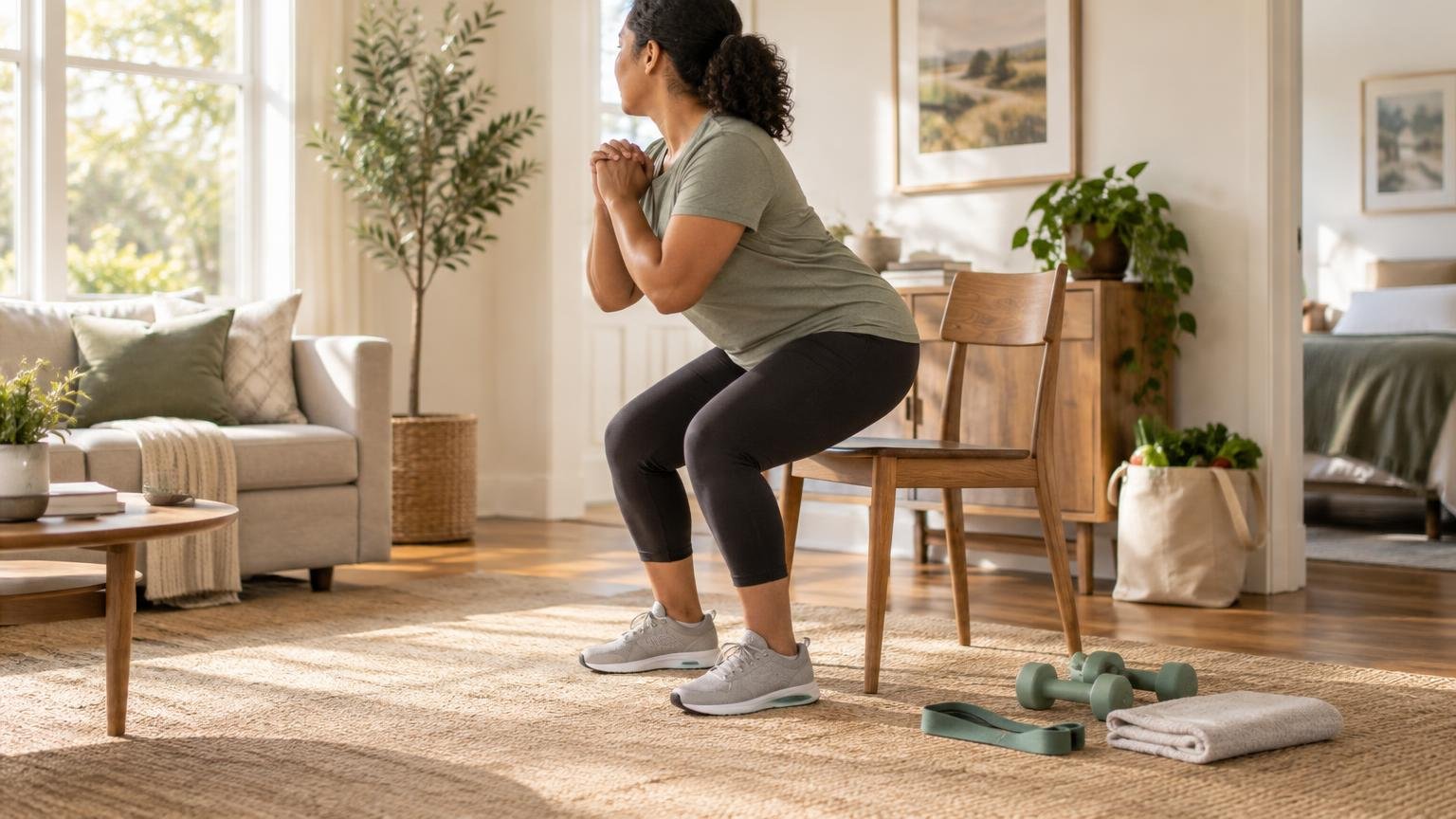
A chair makes the squat pattern approachable and gives you a clear destination. Start from a seat height that feels manageable. Lean forward slightly, place your feet firmly on the floor, and stand without using momentum. To make it easier, use your hands lightly on the chair or a counter. To progress, use less hand support, slow the lowering phase, or hold a light object.
Hinge
The hinge teaches you to move from the hips while handling a load close to your body. Practice by standing a short distance in front of a wall and reaching your hips back toward it. Once that feels natural, try lifting a light bag from a chair or other stable elevated surface. A shorter range is preferable to forcing a deeper movement that causes your position to unravel.
Push and pull
For pushing, a wall is usually easier than a counter, and a counter is usually easier than the floor. Pick a height at which you can lower and press away with control. For pulling, a resistance band is convenient, but a securely closed bag can work for a supported one-arm row. Check bands, handles, bags, and anchor points before putting force through them.
Carry and core
Carries connect strength training to daily life. Hold two balanced loads or carry one object on one side while walking slowly through a clear space. Core work does not have to mean repeated sit-ups. A bird dog, elevated plank, or stationary suitcase hold asks the trunk to resist unwanted movement while you keep breathing.
How to practice without overcomplicating it
Begin with a few minutes of easy movement and lighter practice repetitions. Then work through your chosen patterns at a calm pace. One controlled set may be enough while you learn; federal guidance notes that a set of roughly 8 to 12 repetitions can be effective, while additional sets may offer more benefit. Treat that as a general reference rather than a requirement. Carries and static core exercises can instead use a short distance or manageable amount of time.
Rest whenever your breathing or technique needs it. The final repetitions should require attention, but they should still resemble the first ones. You do not need to take every set to complete muscular failure. The American College of Sports Medicine reports that home-based, elastic-band, and bodyweight resistance training can improve strength and physical function, while complex programming and a particular equipment type are not essential for the average healthy adult. Read the ACSM position stand overview.
Progress one thing at a time
Progressive overload simply means increasing the challenge as your body adapts. It does not automatically mean buying heavier weights. You can add a repetition, use a slightly larger range of motion, slow part of the movement, improve control, add a set, move to a harder variation, or increase resistance.
Change only one variable at a time, then observe how you feel during the session and over the following day or two. If your technique becomes noticeably less steady, return to the previous version. Progress that you can repeat is more useful than one heroic workout followed by a long interruption.
Make recovery part of the pattern
Strength work is only one part of an active week. Walking, active errands, and movement breaks can complement it without every activity becoming a formal workout. Our guide to making everyday movement count offers low-pressure ways to stay active between sessions.
Allow time between challenging sessions for the same muscles, eat regular nourishing meals, and protect your sleep where possible. Some temporary muscle fatigue or mild soreness can happen after unfamiliar activity, but sharp pain, chest pain, dizziness, or a joint that feels unstable is a reason to stop. The National Institute on Aging advises beginners to start without weights or bands until movements feel comfortable, avoid holding their breath, and listen to their bodies rather than continually adding more work. Its beginner exercise guidance also recommends seeking professional help when uncertain about a movement.
If you have a chronic condition, disability, persistent pain, recent injury, or concerns about balance, ask a clinician or qualified physical-activity professional how to adapt the exercises. Activity can often be adjusted to a person's abilities, but the appropriate movements and amount are individual.
Frequently asked questions
Do I need dumbbells to get stronger at home?
No. Body weight, bands, stairs, loaded bags, and household objects can provide resistance. Dumbbells may make small increases easier to measure, but they are an option rather than a starting requirement.
How often should a beginner do full-body strength training?
Two nonconsecutive days per week is a practical place to begin and aligns with federal guidance to strengthen all major muscle groups on at least two days each week. Your recovery, health, and current activity level may affect what is appropriate.
What if I cannot do a floor push-up or plank?
Use a wall or sturdy counter to reduce the load. As your control improves, move to a lower surface. An easier variation performed well is not a lesser exercise; it is the version that lets you practice the pattern consistently.
How do I know when to make an exercise harder?
Consider a small progression when you can complete your current version with steady technique, normal breathing, and no concerning pain. Add one modest challenge and keep the rest of the exercise familiar.
Start with the version you can repeat
For your first session, choose one easy exercise from each of the six patterns and practice it without chasing fatigue. Write down the variation you used and one cue that helped. Repeat the same pattern later in the week. That small, familiar structure gives you something much more valuable than a punishing one-off workout: a strength habit with room to grow.
References
- Physical Activity Guidelines for Americans, 2nd edition
- American College of Sports Medicine Position Stand. Resistance Training Prescription for Muscle Function, Hypertrophy, and Physical Performance in Healthy Adults: An Overview of Reviews.
- Three Types of Exercise Can Improve Your Health and Physical Ability | National Institute on Aging
- Adding Physical Activity as an Adult | Physical Activity Basics | CDC